Rather than duplicate the excellent content already on the net, I’ll concentrate my pages on what I’ve specifically learned or added to the community. For the central core of the whole thing, you need to visit https://meshcore.io – this is the project that started it all and the open-source centre of all firmwares. If you want to discuss MeshCore with other users (including the developers) then they run a Discord server here: https://discord.gg/Q3PFnVCKk
I’ve also designed a repeater PCB that maybe you can build for yourself. It addresses the Achilles heel of operating solar repeaters through the winter (risk of complete discharge leading to a failure to automatically reboot when the sun shines again). Read more about that here: Spiffing Mesh Repeater
I can be contacted via Discord, suggest you join the MeshCore.io discord (link above) and then search for me as a user on there – IT-Orp-S omni
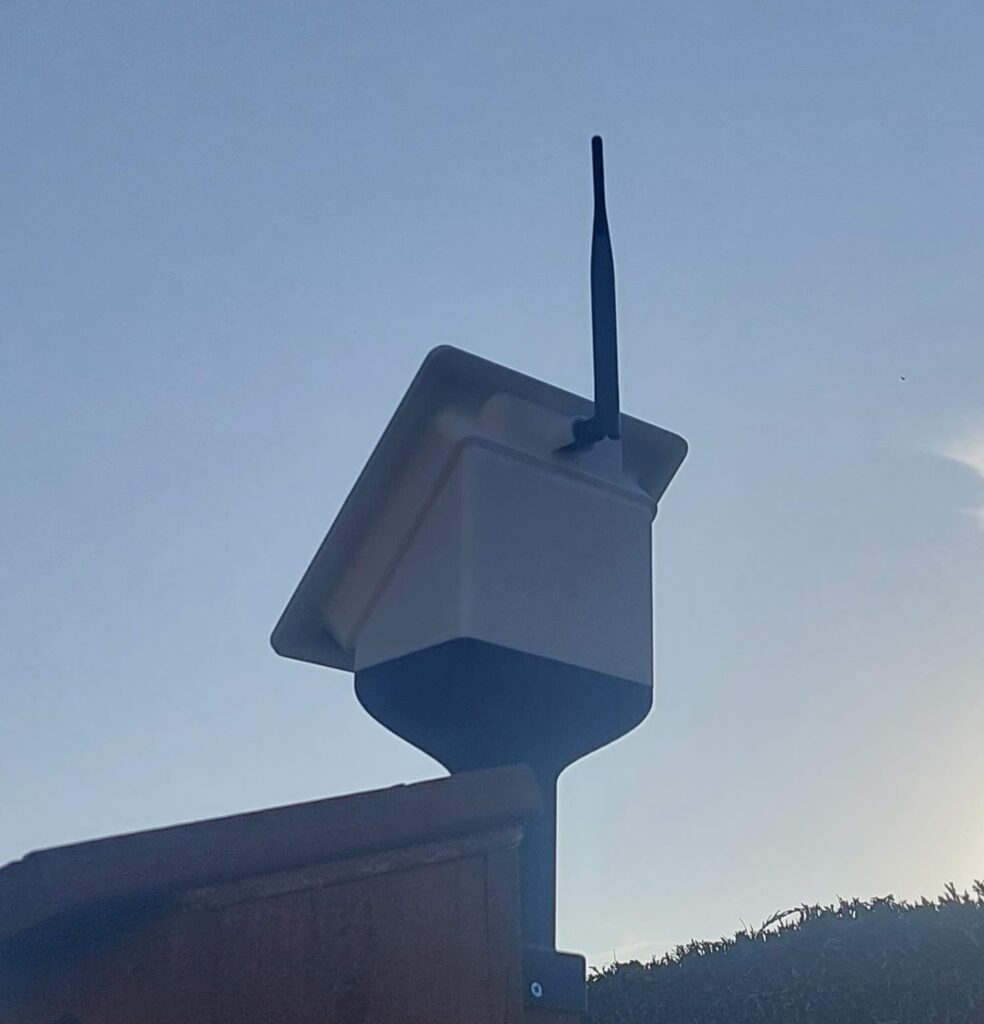
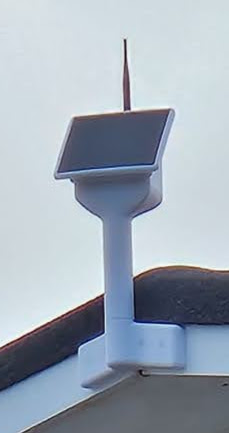
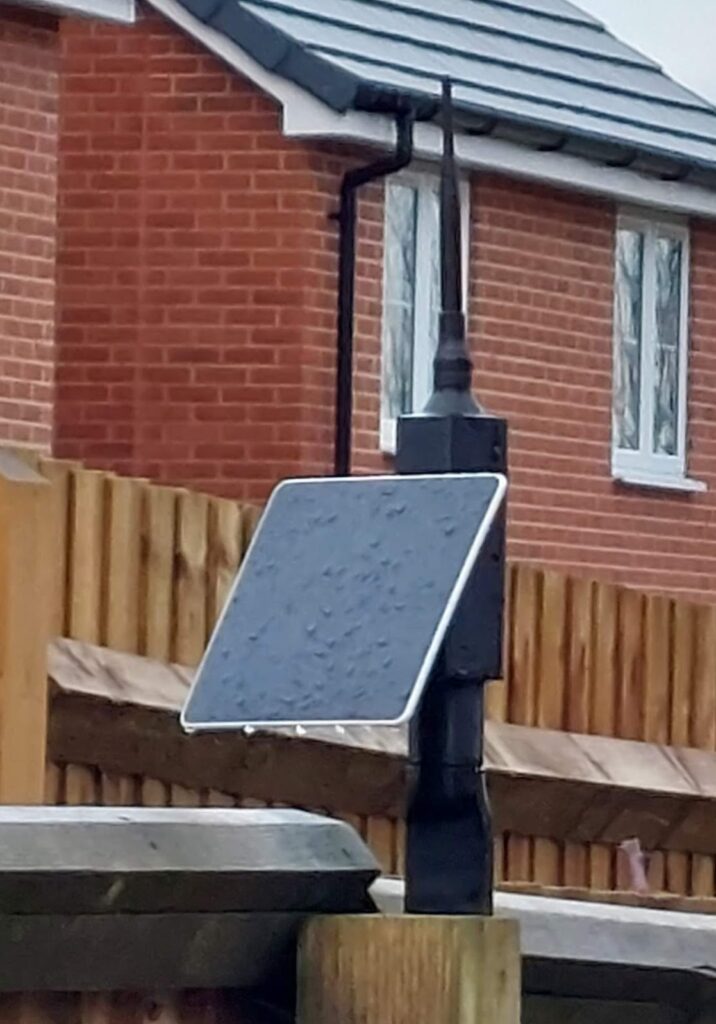
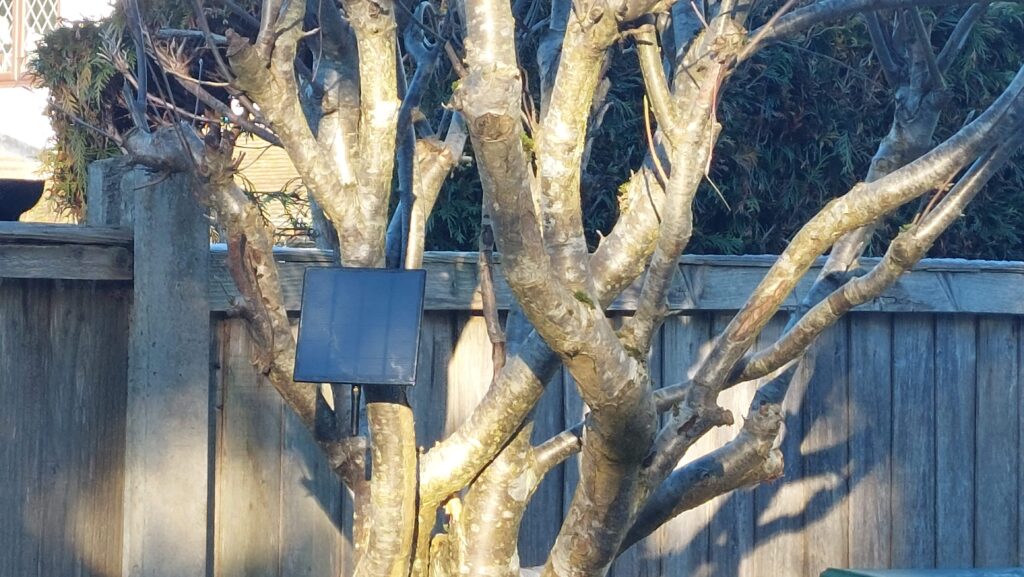
Repeaters come in all shapes and sizes, here are some of mine.
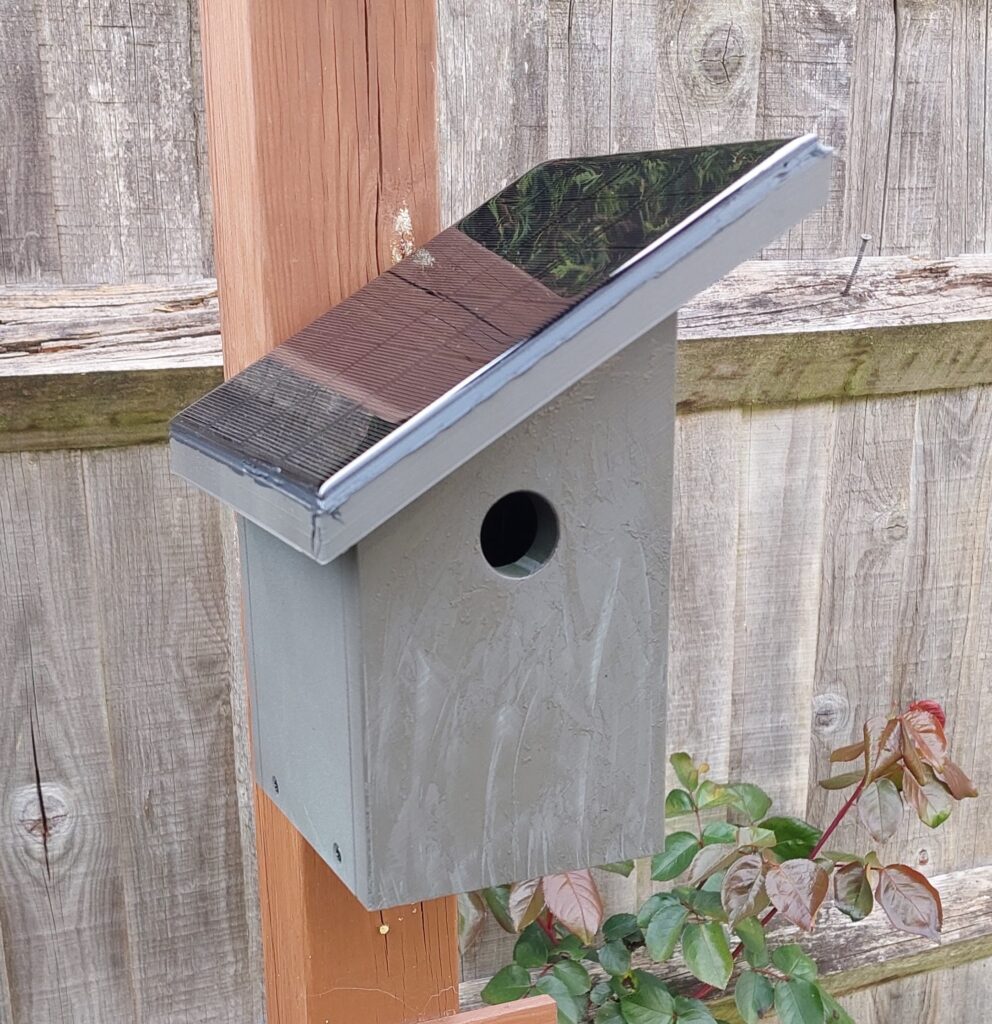
My first design, from Sept 2025 – this is in my back garden at home and has proven to be a rock-solid reliable design so far. It has 4 x 2,000mAh Lithium-Ion cells in parallel, charged by a 165x165mm 6V solar panel and a TP4065 module. It received some upgrades early on (adding INA219 and a change of antenna), but apart from (bluetooth) firmware upgrades, it has been left untouched since. The look I was going for was ‘street furniture’ and I’m pretty sure this could be printed in grey, strapped to the top of any pole in the street and go largely unnoticed.Here’s my second repeater – still of the same overall design. Fitted with a bespoke bracket to exactly match the gable ends of the building it’s mounted on. This is a year-round design with 12,000mAh of power and a 182x182mm glass solar panel and a nRF Xiao Wio kit, INA219 and TP4056. The white body has proven very effective in the recent hot weather at keeping the cells below 60 C and yet during the winter there’s sufficient self-heating from the panel to warm the cells to be comfortably above zero for charging.My third design, a super-compact, lower profile repeater containing exactly the same components (4 x 2,500mAh cells, nRF Xiao WIO kit, INA219 and TP4056, but this time incorporating one of the cheap Amazon solar panels. While this panel continues to function just fine, I’ve since designed a replacement mount for my favoured 165x165mm panel. Any new ones that I build will use that instead, as it’s better in low light and cheaper.Even so, this has survived the winter without reboot and I’d suggest is a robus, proven design now, that lends itself to mounting on a fence (as shown), a pole or wall bracket (I’ve designed and printed both of these).“Tiny” – this is my smallest repeater, which was designed and built as an experiment and still packs 3 x 3,000mAh cells, a nRF Xiao WIO kit, TP4056 and INA219. with a barely-capable 110x110mm solar panel. Great for somewhere with really good sun, but barely makes it through winter. This really is small, no deeper than two 18650 cells in the body behind the panel, tapering to the thickness of the solar panel surround at the top. The angle of the panel is firmly optimised for winter charging, my logic being that there’s an excess of energy available in the summer – which has been proven correct.An interesting idea here, I built a repeater inside a shell designed to look like a bird box. All reasonably sized (with the exception of the larger roof ‘plank’ sized to fit a 165x165mm panel. This has the antenna fitted internally, upside down in the right-front corner. I’ve not fitted this to a tree yet, but the angle of the solar panel is intended to go somewhere with a good South-East facing clear trunk. I realise that means it needs to go somewhere that has previously been maintained as completely natural woodland commonly has branches down to very low level, which would shade it too much.
![[Abs-Zero]](https://www.abs-zero.com/wordpress/wp-content/uploads/2013/11/abs-zero.jpg)